In my complete guide to brain aneurysms and cerebrovascular surgery, I described subarachnoid haemorrhage as an immediately life-threatening event that warrants emergency medical attention. I want to expand that section into a dedicated guide, because subarachnoid haemorrhage from a ruptured brain aneurysm is one of the neurosurgical emergencies where the gap between what patients and families know at the time it happens and what they need to do is most dangerous. The classic thunderclap headache, the symptom that should trigger an immediate call to emergency services, is frequently dismissed as a migraine, a tension headache, or a panic attack. That delay, the time between the headache starting and the patient reaching emergency imaging, is the interval during which the difference between a good neurological outcome and death or permanent disability is determined. As a neurosurgeon and neuroendovascular specialist at SPARSH Hospital, Infantry Road, Bengaluru, trained in cerebrovascular surgery at GB Pant Hospital and Maulana Azad Medical College, New Delhi, the management of subarachnoid haemorrhage is one of the most urgent clinical situations I encounter, and this guide is written so that anyone who reads it will know exactly what to do when the thunderclap headache arrives.
What the Thunderclap Headache Is and Why It Is Different from Every Other Headache
The thunderclap headache is not simply a severe headache. It is a headache that reaches maximal severity within seconds of onset, described by patients who have experienced it as the worst pain of their entire life, appearing as if something has exploded inside the head. This explosive character, the immediacy of maximal severity from the very first second, is what distinguishes subarachnoid haemorrhage from migraine, from tension headache, and from almost every other cause of head pain. A migraine builds over minutes to hours. The thunderclap headache is already at its worst before the person has time to sit down. It is typically accompanied by nausea, vomiting, an extreme sensitivity to light, and a stiffness in the neck that develops over the first hours as blood in the subarachnoid space irritates the meninges. In severe haemorrhages, loss of consciousness occurs at onset, and the person collapses. Any sudden severe headache that reaches its maximum intensity within seconds, that the person describes as unlike any headache they have had before, must be treated as a subarachnoid haemorrhage until imaging proves otherwise. This is not a situation for paracetamol and a dark room. It is a situation for an ambulance.
What Happens in the Emergency Room and Why Imaging Is Urgent
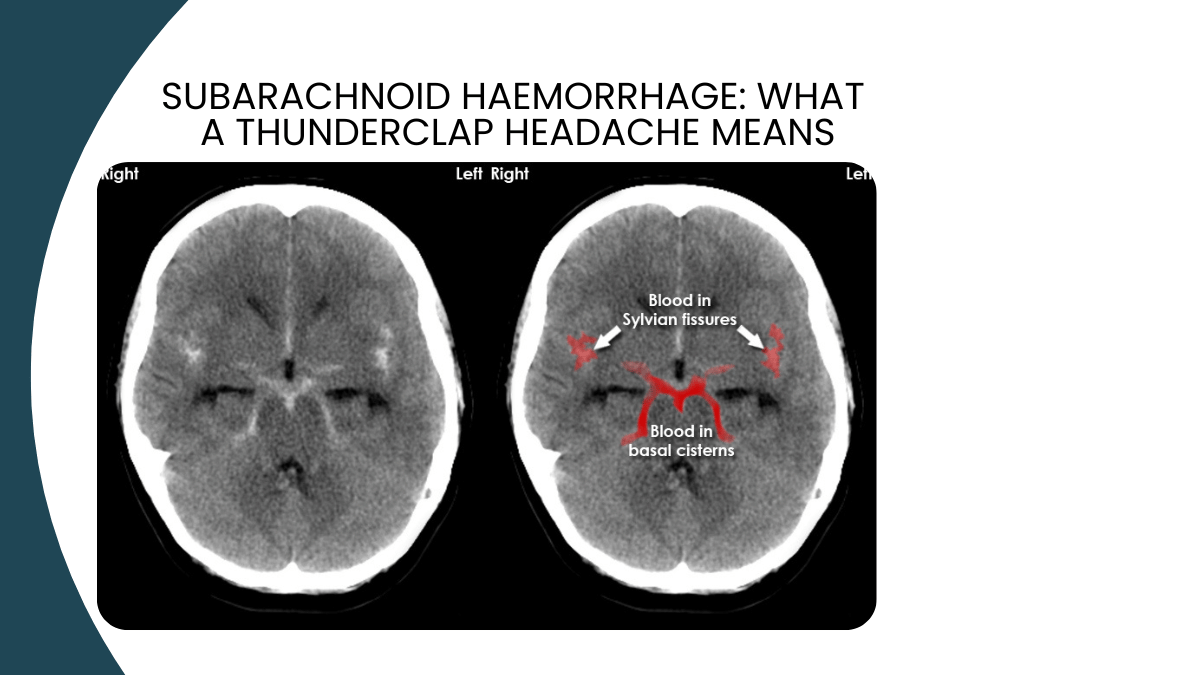
When a patient arrives in the emergency department with a thunderclap headache, the first investigation is a non-contrast CT scan of the brain. In the first 12 hours after subarachnoid haemorrhage, CT detects blood in the subarachnoid space with very high sensitivity: the bright white appearance of blood in the cisterns and fissures surrounding the brain is immediately recognisable on the scan. As the hours pass, the sensitivity of CT falls as the blood becomes progressively isodense with brain tissue, which is why the earlier the imaging is performed, the more reliable the result. If the clinical suspicion for subarachnoid haemorrhage remains high despite a normal CT, a lumbar puncture is performed to examine the cerebrospinal fluid for xanthochromia, the yellow discolouration that results from haemoglobin breakdown in the CSF, which persists for days after a haemorrhage and represents the most sensitive test for SAH at later time points. Once subarachnoid haemorrhage is confirmed, CT angiography of the intracranial vessels is performed urgently to identify the ruptured aneurysm, its location, size, and anatomy, so that treatment planning can begin immediately. The entire sequence from CT confirmation to aneurysm treatment, in an experienced centre like SPARSH Hospital, Bengaluru, takes hours, not days, because the ruptured aneurysm carries a very high risk of rebleeding in the first 24 hours, and rebleeding dramatically worsens outcomes.
Vasospasm: The Most Dangerous Complication After the Initial Bleed
The successful treatment of the ruptured aneurysm, whether by endovascular coiling or surgical clipping, eliminates the immediate risk of rebleeding. But it does not end the danger. The most important and most feared complication in the days that follow subarachnoid haemorrhage is vasospasm: a pathological narrowing of the cerebral arteries in response to the blood that has bathed them during the haemorrhage. Vasospasm begins to develop between days four and ten after the bleed, peaks around days seven to ten, and can produce delayed cerebral ischaemia, essentially a stroke, that causes neurological deterioration in a patient who may have been recovering well from the initial haemorrhage. Vasospasm is the reason every patient with subarachnoid haemorrhage requires careful monitoring in a neurosurgical intensive care unit for at least ten to fourteen days, regardless of how well they appear to be doing clinically. The management of vasospasm includes maintaining adequate blood pressure, blood volume, and cardiac output to drive blood through the narrowed vessels, using a calcium channel blocker called nimodipine which reduces vasospasm severity, and in severe cases, endovascular treatment of the vasospasm itself using balloon angioplasty or intra-arterial vasodilator infusion delivered through the same catheter-based route used for aneurysm coiling. Understanding vasospasm is important for families whose relative has been treated for a ruptured aneurysm: the critical period does not end with the procedure that secures the aneurysm. The ten to fourteen days after subarachnoid haemorrhage require the same vigilance as the first hours, and the neurosurgical team remains intensively involved throughout this period.
To book a consultation with Dr. Robin Gupta at SPARSH Hospital, Infantry Road, Vasanth Nagar, Bengaluru, call +91 85128 35890.
Written by Dr. Robin Gupta, MBBS, MS (General Surgery), MCh (Neurosurgery, GB Pant Hospital and Maulana Azad Medical College, New Delhi), Consultant Neurosurgeon and Stroke Specialist, Neuroendovascular Surgeon, SPARSH Hospital, Infantry Road, Vasanth Nagar, Bengaluru. 18+ years. 22,000+ patients. Phone: +91 85128 35890.
Related reading
World Brain Day: Why the Clock Is the Most Important Tool in Stroke Care
Revolutionizing Stroke Intervention – Dr. Robin Gupta’s Journey


Add a Comment