Neck pain and arm symptoms are among the most common reasons patients are referred to me at Royal Preston Hospital. When symptoms move beyond simple neck stiffness to include severe arm pain, numbness, weakness, or difficulty with walking and balance, specialist assessment is needed. One of the most frequent causes is cervical disc disease, where degeneration of the discs in the neck places pressure on the nerves or spinal cord. This guide walks through what that means, how it is diagnosed, and when surgery may be the right step.
What is the cervical spine and why does it matter?
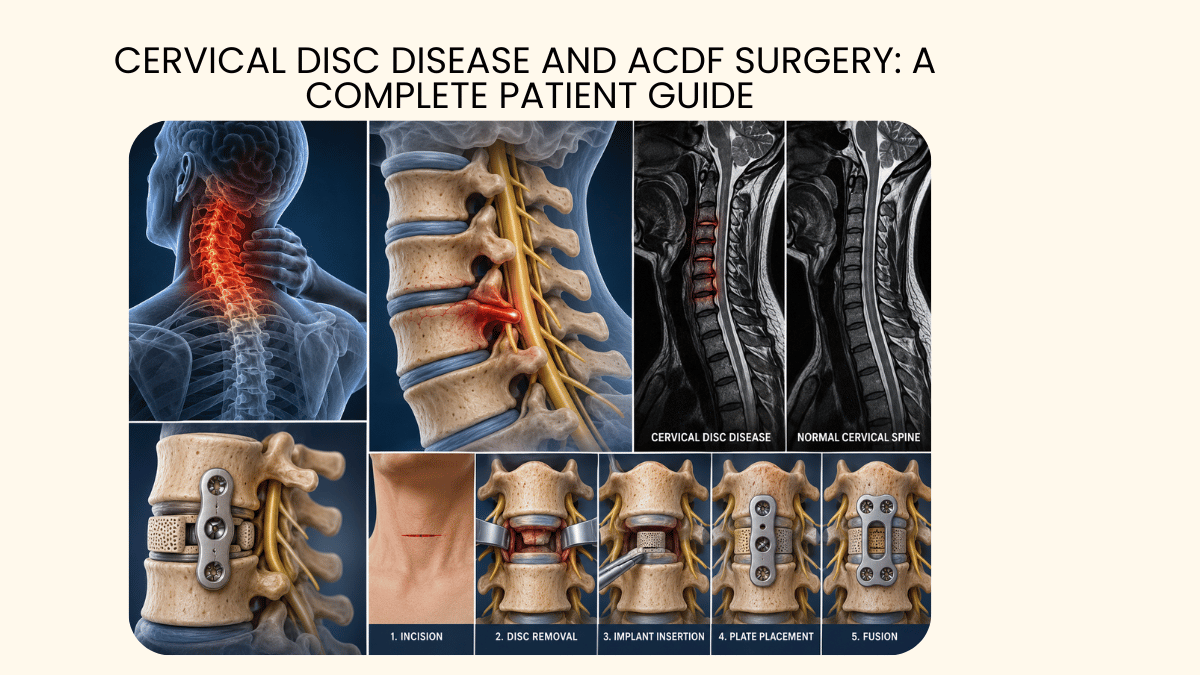
The cervical spine is the upper part of the spine located in the neck, consisting of seven vertebrae numbered C1 to C7. Between each vertebra is a disc that acts as a shock absorber and allows movement, made up of a tough outer layer and a softer inner core. The spinal cord passes through the center of the cervical spine, with nerves branching off and travelling into the shoulders, arms, and hands. Because the spinal cord and nerves occupy a relatively confined space, any narrowing or disc bulge can sometimes lead to significant symptoms.
What is cervical disc disease?
As we age, the discs naturally undergo wear and tear, a process often referred to as cervical spondylosis or cervical degenerative disc disease. The disc gradually loses water content and elasticity, becoming less effective as a shock absorber. Over time this can result in disc bulging, disc prolapse or herniation, bone spur formation, narrowing around nerves, and narrowing of the spinal canal. Many people have age-related changes on MRI scans without experiencing symptoms. Problems arise when these changes begin to compress a nerve root or the spinal cord.
What is a trapped nerve in the neck?
A trapped nerve occurs when a cervical nerve root becomes compressed as it exits the spine. This condition is commonly referred to as cervical radiculopathy. Compression may result from a prolapsed disc, disc degeneration, bone spurs, thickening of ligaments, or narrowing of the neural foramen. When a nerve is compressed, symptoms develop along the course of that nerve.
The most common symptom is arm pain. Patients frequently describe sharp pain shooting down the arm, burning pain, electric shock-like sensations, pins and needles, numbness, and weakness in the arm or hand. Symptoms often affect one arm but may occasionally involve both, and the exact pattern depends on which nerve root is affected.
Nerve root patterns
A C6 nerve root problem typically causes pain and numbness into the thumb, along with weakness of elbow flexion. A C7 problem often produces pain into the middle finger and triceps weakness. A C8 problem may cause hand weakness, loss of dexterity, and numbness affecting the little finger.
What is cervical myelopathy and how is it different?
While nerve root compression affects individual nerves, pressure on the spinal cord itself produces a condition called cervical myelopathy. This is generally more serious because the spinal cord carries signals between the brain and the rest of the body. Symptoms may include difficulty walking, poor balance, frequent falls, loss of hand dexterity, difficulty with buttons or handwriting, weakness in the arms or legs, numbness, and altered bladder function. Cervical myelopathy often develops gradually and may be mistaken for normal ageing. Without treatment, some patients experience progressive deterioration.
When should I seek specialist advice?
Medical assessment should be sought if symptoms include severe arm pain, progressive weakness, loss of hand function, walking difficulties, balance problems, recurrent falls, bladder disturbance, or symptoms that fail to improve after conservative treatment. Urgent assessment may be required if significant neurological deterioration occurs.
How is cervical disc disease diagnosed?
Diagnosis involves a combination of clinical assessment and imaging. I will take a full symptom history, assess the impact on daily activities, and perform a neurological examination covering muscle strength, reflexes, sensation, balance, and coordination. MRI scan is usually the most useful investigation, providing detailed information regarding disc prolapse, nerve compression, spinal cord compression, and degenerative changes. A CT scan may provide additional information regarding bone anatomy and spinal alignment. X-rays help assess stability, alignment, and degenerative changes.
Can cervical disc disease be treated without surgery?
Yes. Most patients improve without surgery. Treatment options may include activity modification, physiotherapy, pain medication, neuropathic pain medication, and lifestyle changes. Many episodes of cervical radiculopathy improve over several weeks or months. Surgery is usually considered when symptoms persist despite appropriate treatment or when significant neurological problems develop.
When is surgery recommended?
Surgery may be considered when arm pain remains severe despite conservative treatment, when weakness develops, when symptoms continue to worsen, when MRI demonstrates significant nerve compression, when cervical myelopathy is present, or when quality of life is significantly affected. The decision to proceed with surgery is always individual and should involve careful discussion of benefits, risks, and alternatives.
What is ACDF surgery and how does it work?
ACDF stands for Anterior Cervical Discectomy and Fusion. It is one of the most commonly performed operations for cervical nerve root or spinal cord compression. The operation is performed through the front of the neck under general anaesthesia. The procedure involves accessing the cervical spine through a small incision, removing the damaged disc, removing material compressing the nerve or spinal cord, restoring disc height, inserting a cage or implant, and allowing the vertebrae to fuse together. In some cases, a titanium plate may also be used.
The goals depend on the reason for surgery. For cervical radiculopathy, the primary aim is relief of arm pain. For cervical myelopathy, the primary aim is to prevent further neurological deterioration, since recovery varies depending on the duration of symptoms, severity of cord compression, and existing neurological deficit.
What symptoms are most likely to improve after ACDF?
Arm pain, tingling, and nerve-related symptoms are most likely to improve. Numbness and weakness show variable improvement. Neck pain is less predictable. Patients are often surprised to learn that surgery performed for nerve compression is not primarily intended to treat neck pain, and some may experience persistent neck discomfort even after a successful procedure.
What are the risks of ACDF surgery?
All surgery carries risk. Serious complications are uncommon, but it is important that patients understand them before proceeding. Specific risks include infection, bleeding, swallowing difficulties, hoarseness from vocal cord nerve irritation, cerebrospinal fluid leak, nerve injury, spinal cord injury, stroke, non-union of the fusion, implant problems, and adjacent segment disease. General anaesthetic risks include heart complications, pneumonia, deep vein thrombosis, and pulmonary embolism. Serious complications and death are rare but recognised risks of major surgery.
Non-union, where the vertebrae fail to fuse successfully, is more likely in patients who smoke, have diabetes, or have poor bone quality. I discuss all relevant risks individually with each patient before any decision to proceed.
What does recovery after ACDF look like?
Most patients spend one or two nights in hospital. In the first two weeks, recovery after ACDF surgery involves wound healing, management of neck discomfort and fatigue, and gentle walking. Between two and six weeks, activity gradually increases and mobility improves with a return to light daily activities. Between six and twelve weeks, most patients return to many normal activities as the fusion continues to heal. Fusion itself continues to mature over many months. Driving should only resume when you can safely control the vehicle, turn your head adequately, are no longer impaired by medication, and have confirmed compliance with your insurer's requirements.
Questions patients ask me most often:
Will surgery cure my neck pain?
Not necessarily. ACDF is primarily designed to relieve nerve or spinal cord compression rather than neck pain itself.
Will numbness disappear?
Numbness may improve, but recovery is often less predictable than relief of pain.
Will I lose movement in my neck?
A fusion does reduce movement at the operated level, but most patients notice little functional limitation in daily life.
How successful is ACDF?
For appropriately selected patients with cervical radiculopathy, ACDF is a well-established procedure that can provide meaningful relief of arm pain caused by nerve compression.
Can symptoms come back?
Yes. Future degeneration can occur elsewhere in the cervical spine, and symptoms at adjacent levels may develop over time.
If you are experiencing arm pain, numbness, weakness, or walking difficulties that may be related to cervical disc disease or nerve compression, I would be happy to assess your situation and discuss whether surgical or non-surgical management is appropriate. To book a consultation with Mr Anantharaju Prasad at Royal Preston Hospital, Preston, call 01772 522740.
Written by Mr Anantharaju Prasad, MBBS, DNB (Neurosurgery), FRCS (SN), Consultant Neurosurgeon, Royal Preston Hospital, Sharoe Green Ln, Fulwood, Preston PR2 9HT, United Kingdom.


Add a Comment